

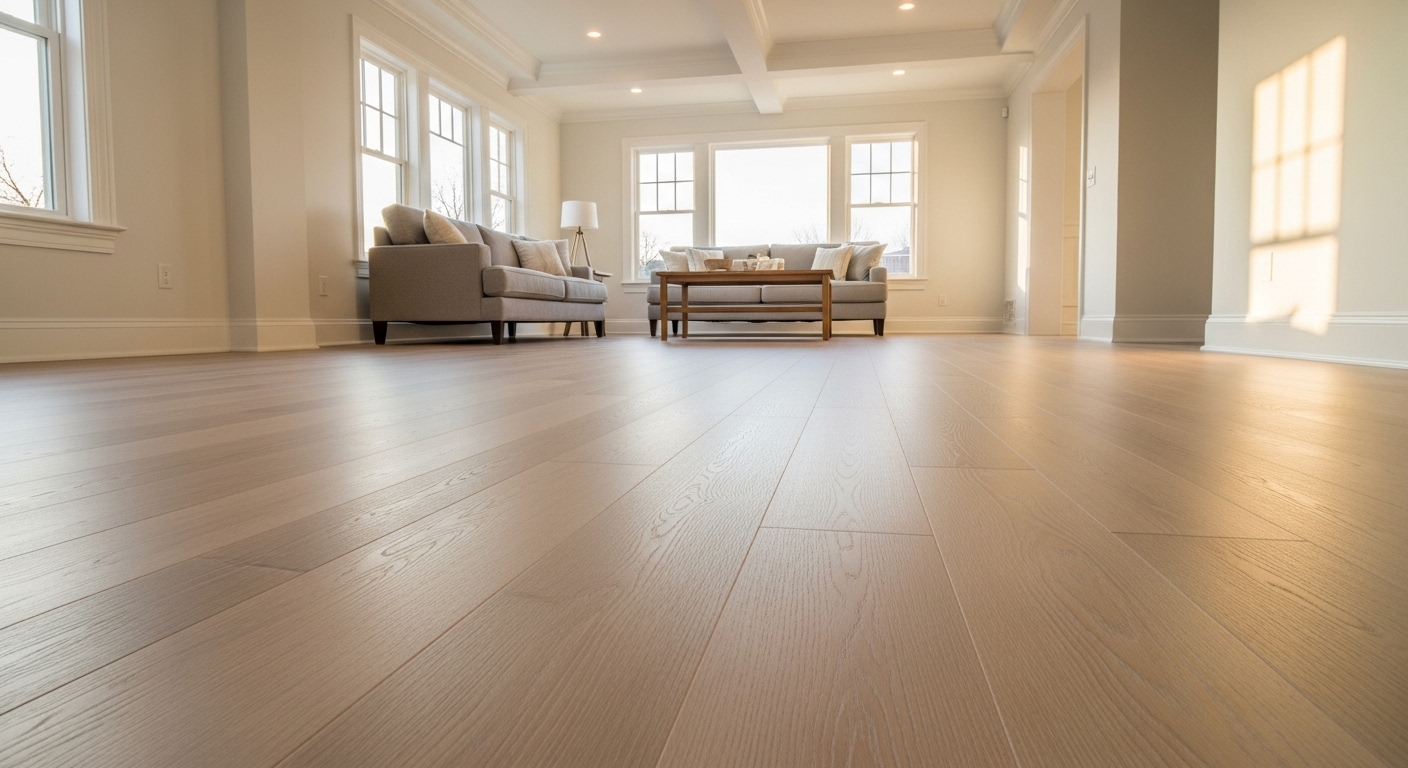
Is your hardwood floor trying to tell you something? Most homeowners wait far too long before asking the critical question of when to replace hardwood floors — and that delay often turns a manageable renovation into a costly emergency. The truth is that hardwood floors give clear warning signs before they reach the point of no return, and knowing how to read those signs can save you thousands of dollars.
Understanding when to replace hardwood floors — versus when refinishing is still a viable option — is one of the most important decisions a homeowner can make. The wrong choice in either direction is expensive: replacing floors that could have been refinished wastes money, while refinishing floors that genuinely need replacement only delays the inevitable and can mask serious structural problems.
In this complete guide, you will learn the 8 definitive warning signs that indicate when to replace hardwood floors, how to distinguish replacement from refinishing situations, and what your options are when replacement becomes necessary.
Continue reading to discover exactly when to replace hardwood floors and how to make the right decision for your home.
Not sure whether your floors need refinishing or full replacement? Get a free professional assessment from Prime Epoxy Flooring — no obligation.
Why Knowing When to Replace Hardwood Floors Matters for Your Home and Budget
The decision of when to replace hardwood floors is not just aesthetic — it has direct financial implications for your home’s value, structural integrity, and your family’s safety. Hardwood floor replacement is a significant investment, typically costing $6–$12 per square foot installed. Making the right call at the right time protects that investment and avoids unnecessary expense.
There are two costly mistakes homeowners make in this decision:
Replacing too early: Floors that show surface wear, light scratches, or a dull finish can almost always be restored through professional refinishing at $3–$5 per square foot — a fraction of replacement cost. Replacing these floors prematurely wastes thousands of dollars.
Replacing too late: Floors with structural damage, severe moisture intrusion, or wood that has been sanded past its usable thickness cannot be saved by refinishing. Continuing to refinish these floors only delays replacement while the underlying problems worsen.
The key to making the right decision is knowing the specific warning signs that indicate when to replace hardwood floors versus when refinishing is still the right answer.
At Prime Epoxy Flooring, we assess hardwood floors across Delaware and Pennsylvania every day. Our team helps homeowners in Wilmington, Newark, King of Prussia, and beyond make this decision with confidence — and without overspending.
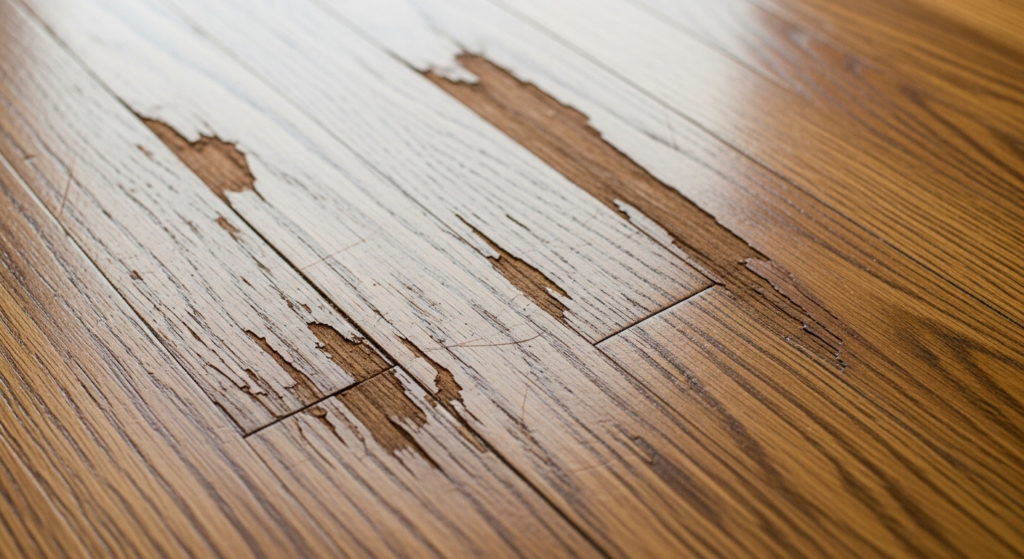
Refinish or Replace? Understanding the Core Decision
Before examining the specific warning signs for when to replace hardwood floors, it is important to understand the fundamental framework for this decision.
| Condition | Refinish | Replace |
|---|---|---|
| Surface scratches and scuffs | Yes | No |
| Dull or worn finish | Yes | No |
| Light staining on the surface | Yes | No |
| Deep scratches through to bare wood | Sometimes | If widespread |
| Boards sanded to minimum thickness | No | Yes |
| Severe moisture damage / warping | No | Yes |
| Structural subfloor damage | No | Yes |
| Widespread rot or mold | No | Yes |
| Boards that cannot be matched | No | Yes |
| Engineered wood with thin veneer | No | Yes |
This framework gives you an immediate starting point. The 8 warning signs below provide the detailed guidance you need to apply this framework to your specific floors.
The 8 Critical Warning Signs That Tell You When to Replace Hardwood Floors
Warning Sign 1: The Floor Has Been Sanded Too Many Times
One of the clearest indicators of when to replace hardwood floors is a floor that has been sanded to or beyond its minimum usable thickness. Solid hardwood planks are typically 3/4 inch thick, with approximately 1/4 inch of usable wood above the tongue-and-groove joint. Each refinishing cycle removes approximately 1/32 inch of wood. After 5–8 refinishing cycles, the floor reaches a point where further sanding is not safe.
How to check if your floor has been over-sanded:
- Look at the edge of a plank near a vent or threshold where the full thickness is visible
- If the distance from the top surface to the top of the tongue is less than 3/32 inch, the floor cannot be safely sanded again
- Look for visible fasteners (nails or staples) near the surface — this indicates the floor has been sanded too thin
- Check for beveled edges that have been sanded flat — this indicates significant material removal
If your floor has reached this point, refinishing is no longer an option and replacement is the only path forward. This is one of the most definitive indicators of when to replace hardwood floors.
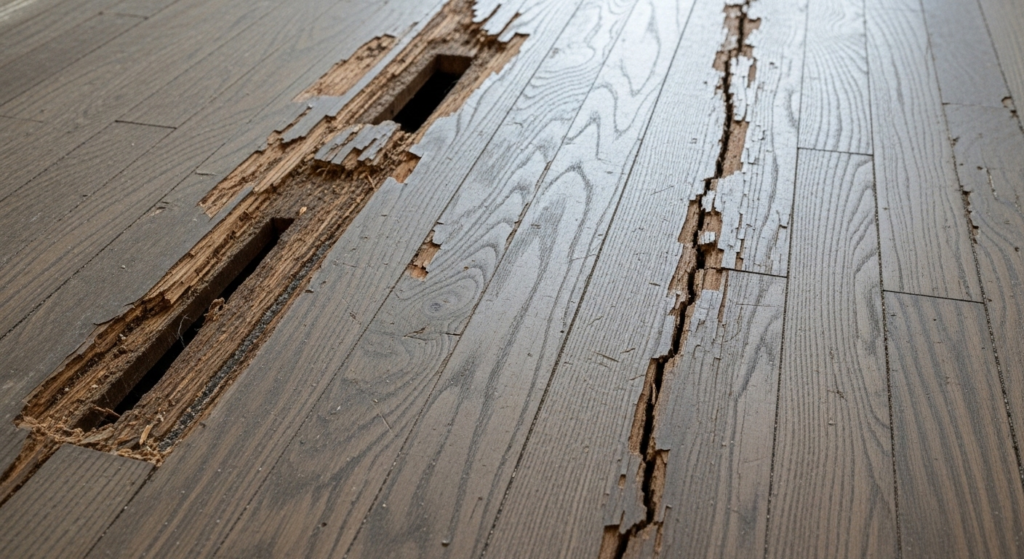
Warning Sign 2: Severe and Widespread Moisture Damage
Moisture damage is the most common reason homeowners face the question of when to replace hardwood floors in Delaware and Pennsylvania. The region’s humid summers, variable seasonal conditions, and prevalence of older homes with concrete slab foundations create significant moisture challenges for wood flooring.
Signs of moisture damage that indicate replacement:
- Cupping: The edges of planks are higher than the center, creating a concave surface across the width of each board
- Crowning: The center of planks is higher than the edges — often a sign of previous cupping that was sanded incorrectly
- Buckling: Planks have lifted completely off the subfloor, creating raised sections
- Widespread warping: Multiple planks are twisted or bowed along their length
- Black staining: Dark discoloration that has penetrated deep into the wood fibers, indicating long-term moisture exposure
Mild cupping caused by a temporary humidity spike can sometimes be reversed by correcting the humidity and allowing the floor to dry. However, severe or long-standing moisture damage that has caused structural deformation of the planks indicates when to replace hardwood floors rather than attempt refinishing.
For homeowners in Rehoboth Beach, DE, Edgemoor, DE, and Townsend, DE — where coastal and seasonal moisture is a persistent challenge — moisture damage is the most frequent reason our team recommends replacement.
Warning Sign 3: Rot, Mold, or Structural Decay
The presence of rot, mold, or structural decay is an unambiguous indicator of when to replace hardwood floors. These conditions cannot be addressed by refinishing — they represent a fundamental failure of the wood’s structural integrity and, in the case of mold, a potential health hazard.
Signs of rot and mold:
- Soft spots or spongy areas when you walk across the floor — the wood compresses under foot pressure
- Visible dark spots or fuzzy growth on the surface or between planks
- A persistent musty odor that does not resolve with cleaning
- Planks that crumble or break when pressure is applied
- Discoloration that is black, green, or gray and does not respond to cleaning
If rot or mold is present, the affected planks must be removed and the subfloor inspected for damage before new flooring is installed. This is a clear case of when to replace hardwood floors, and the underlying moisture source must be identified and corrected before replacement to prevent recurrence.
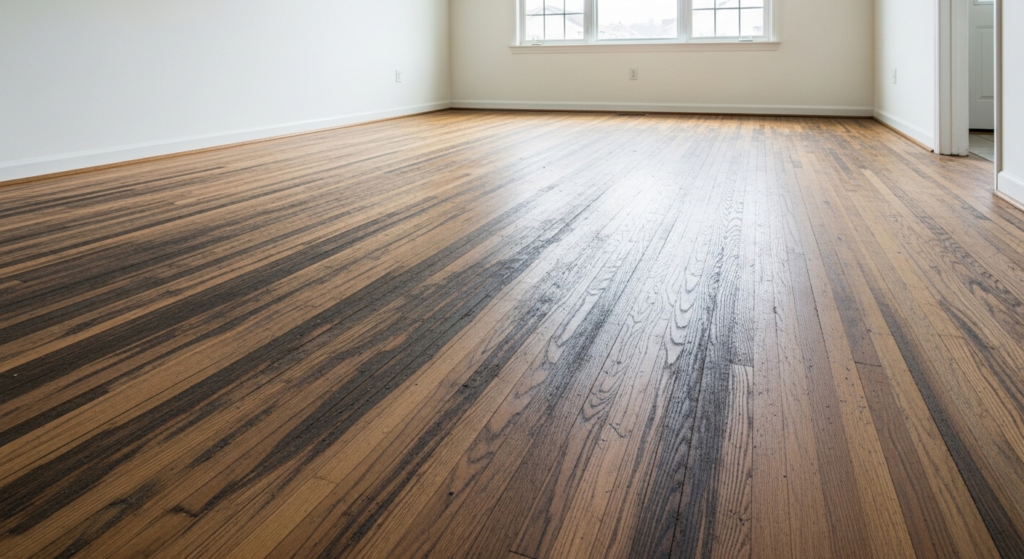
Warning Sign 4: Widespread Deep Scratches and Gouges That Cannot Be Sanded Out
Surface scratches that affect only the finish layer can be addressed through professional refinishing. However, deep gouges and scratches that have penetrated through the finish and into the wood fiber itself — particularly when they are widespread across the floor — may indicate when to replace hardwood floors rather than refinish.
The key distinction is depth and coverage:
- Refinishable: Scratches that are visible but do not catch your fingernail when you run it across the surface
- Potentially refinishable: Scratches that catch your fingernail but are limited to a small area
- Replacement indicator: Deep gouges that are widespread across the floor, particularly in high-traffic areas, and would require removing so much material during sanding that the floor would be brought below minimum thickness
For engineered hardwood with a thin veneer (2–3mm), even moderate scratching that has penetrated the veneer may indicate when to replace hardwood floors, since there is insufficient material for sanding.
Warning Sign 5: Significant Gaps Between Planks That Cannot Be Corrected
Some seasonal gapping between hardwood planks is normal — wood contracts in dry winter months and expands in humid summer months. However, permanent, significant gaps that do not close during the humid season indicate a more serious problem and may signal when to replace hardwood floors.
Normal vs. replacement-indicating gaps:
| Gap Type | Cause | Action Required |
|---|---|---|
| Seasonal gaps (close in summer) | Normal humidity cycling | Humidity management |
| Small permanent gaps (under 1/8 inch) | Aging, minor shrinkage | Filler or refinishing |
| Large permanent gaps (over 1/4 inch) | Severe shrinkage, subfloor movement | Assessment for replacement |
| Widespread gaps with raised edges | Moisture damage | Replacement likely needed |
| Gaps with visible subfloor | Severe shrinkage or damage | Replacement required |
Large, permanent gaps that expose the subfloor or create tripping hazards are a clear indicator of when to replace hardwood floors. These gaps also allow moisture, debris, and pests to access the subfloor, potentially causing additional damage over time.
Warning Sign 6: Subfloor Damage Beneath the Hardwood
The condition of the subfloor is one of the most important factors in determining when to replace hardwood floors. Even if the hardwood surface appears salvageable, a damaged subfloor makes replacement necessary — and attempting to refinish over a compromised subfloor will only result in premature failure of the new finish.
Signs of subfloor damage:
- Squeaking or creaking that is widespread and does not respond to targeted repairs
- Soft spots or springiness when walking across the floor
- Visible movement or flex in the floor when weight is applied
- Water damage visible at the edges of the floor near walls or under baseboards
- Evidence of pest damage (termites, carpenter ants) in the subfloor
When subfloor damage is present, the hardwood must be removed to assess and repair the subfloor before new flooring is installed. This is a definitive case of when to replace hardwood floors, and the subfloor repair must be completed before any new flooring is installed.
Prime Epoxy Flooring’s assessment team evaluates both the hardwood surface and the subfloor condition during every inspection, ensuring that homeowners in Middletown, DE, Bear, DE, and Smyrna, DE receive a complete picture of their floor’s condition.
Is It Time to Replace Your Hardwood Floors?
If you are seeing any of these warning signs in your home, the team at Prime Epoxy Flooring can give you a definitive answer. We provide free, no-obligation floor assessments across Delaware and Pennsylvania — and we will always tell you honestly whether refinishing or replacement is the right choice for your specific situation. Schedule your free assessment today.
Warning Sign 7: The Floor Cannot Be Matched for Repairs
Sometimes the question of when to replace hardwood floors is not about the condition of the existing floor — it is about the impossibility of matching it for repairs. This situation arises when:
- The existing species is discontinued or no longer widely available
- The existing planks are a non-standard width or thickness that cannot be sourced
- The existing floor has developed a patina or color that cannot be replicated with new wood
- A significant portion of the floor (more than 30%) needs to be replaced due to damage, making a full replacement more practical than a patchwork repair
In these cases, attempting to repair or partially replace the floor creates a visually inconsistent result that can actually reduce the home’s value. A full replacement with a new, cohesive species and finish is often the better investment.
This is a particularly common situation in older homes throughout Norristown, PA, Glen Mills, PA, and Broomall, PA, where original hardwood floors from the 1950s and 1960s may use species or dimensions that are no longer in production.
Warning Sign 8: The Floor Has Reached the End of Its Functional Lifespan
The final indicator of when to replace hardwood floors is simply age combined with cumulative wear. Solid hardwood floors can last 50–100 years with proper maintenance, but engineered hardwood typically lasts 25–50 years. When a floor has reached the end of its functional lifespan — characterized by multiple compounding issues rather than a single problem — replacement is the most practical and cost-effective solution.
Signs that a floor has reached end-of-life:
- Multiple warning signs from this list are present simultaneously
- The floor has been refinished the maximum number of times (5–10 for solid, 1–3 for engineered)
- The cost of repairs and refinishing approaches or exceeds the cost of replacement
- The floor’s appearance cannot be meaningfully improved through any maintenance or refinishing service
- The homeowner is preparing to sell the home and the floor’s condition is a liability
When multiple issues converge, the answer to when to replace hardwood floors becomes clear: the time is now.
When to Replace Hardwood Floors vs. When to Refinish: A Complete Decision Guide
Use this decision guide to determine whether refinishing or replacement is the right choice for your floors:
Choose refinishing when:
- The floor has surface scratches and finish wear but the wood is structurally sound
- The floor has not been sanded to minimum thickness
- There is no moisture damage, rot, or mold present
- The subfloor is in good condition
- The floor can be matched for any necessary repairs
- The cost of refinishing is significantly less than replacement
Choose replacement when:
- The floor has been sanded to or beyond minimum thickness
- Severe moisture damage, warping, buckling, or cupping is present
- Rot, mold, or structural decay is present
- The subfloor is damaged and requires repair
- The floor cannot be matched for repairs
- Multiple compounding issues are present simultaneously
- The cost of refinishing approaches the cost of replacement
Get a professional assessment when:
- You are unsure which category your floor falls into
- The damage is localized and you need expert guidance on repair vs. replacement
- You are preparing to sell your home and need an objective evaluation
Prime Epoxy Flooring provides free professional assessments for homeowners across Delaware and Pennsylvania. Our team will give you an honest evaluation — not a sales pitch — so you can make the right decision for your home and budget.
What Are Your Options When It Is Time to Replace Hardwood Floors?
Once you have determined when to replace hardwood floors, the next decision is what to replace them with. You have several excellent options:
New Solid Hardwood Flooring
Replacing with new solid hardwood is the premium option that delivers the longest lifespan and maximum refinishing potential. Species like white oak, red oak, hickory, and walnut are all excellent choices for Delaware and Pennsylvania homes.
Prime Epoxy Flooring installs solid hardwood across the region, including Media, PA, Greenville, DE, and Rehoboth Beach, DE.
Engineered Hardwood Flooring
If the replacement area includes a basement, kitchen, or any space over a concrete subfloor, engineered hardwood is the recommended choice. It delivers the same real wood appearance as solid hardwood with superior moisture resistance. Explore our complete hardwood and engineered wood flooring services for more information.
Luxury Vinyl Plank (LVP)
For areas where moisture is a persistent concern — or for homeowners who want a lower-maintenance alternative — luxury vinyl plank offers excellent durability and 100% waterproof performance. Prime Epoxy Flooring installs LVP across Greenville, DE, King of Prussia, PA, Media, PA, Norristown, PA, Broomall, PA, and Glen Mills, PA.
Tile Flooring
For kitchens, bathrooms, and entryways where maximum durability and moisture resistance are required, tile is an excellent replacement option. Prime Epoxy Flooring installs tile across Greenville, DE, Media, PA, Glen Mills, PA, Norristown, PA, King of Prussia, PA, and Broomall, PA.
Laminate Flooring
For budget-conscious homeowners who want the look of wood without the maintenance requirements, laminate is a practical alternative. Explore our laminate flooring services for more information.
How Much Does It Cost to Replace Hardwood Floors in Delaware and Pennsylvania?
Understanding the cost of replacement helps homeowners make informed decisions about when to replace hardwood floors versus when to invest in refinishing.
| Replacement Option | Material Cost | Labor Cost | Total Installed Cost | Lifespan |
|---|---|---|---|---|
| Solid Hardwood | $4–$10/sq ft | $3–$8/sq ft | $6–$12/sq ft | 50–100 years |
| Engineered Hardwood | $3–$9/sq ft | $2–$6/sq ft | $5–$10/sq ft | 25–50 years |
| Luxury Vinyl Plank | $2–$7/sq ft | $2–$4/sq ft | $4–$8/sq ft | 20–30 years |
| Laminate | $1–$5/sq ft | $2–$4/sq ft | $3–$7/sq ft | 15–25 years |
| Tile | $2–$10/sq ft | $4–$8/sq ft | $5–$15/sq ft | 50+ years |
For comparison, professional refinishing costs $3–$5 per square foot. If your floor can be refinished, the savings compared to replacement are significant. However, when the warning signs in this guide are present, replacement is the right investment — and choosing the right replacement product ensures you will not face the same decision again for decades.
Real Customer Stories: Recognizing When to Replace Hardwood Floors in Delaware and Pennsylvania
Hearing from homeowners who have navigated this decision provides valuable real-world perspective.
“We had been refinishing our floors every few years for a decade. When Prime Epoxy Flooring came to assess them, they showed us that the boards had been sanded to minimum thickness and there was subfloor damage we had not noticed. We replaced with engineered white oak and the difference is incredible — we wish we had done it sooner.” — Carol T., Wilmington, DE
“Our basement hardwood floors had been cupping for two seasons. I kept hoping it would resolve itself. Prime Epoxy Flooring assessed the floors and found significant moisture damage and early-stage mold. They replaced the floors with engineered hardwood and addressed the moisture source. The new floors are beautiful and we have had no issues since.” — James P., Newark, DE
“We were preparing to sell our home and the floors were in rough shape. Prime Epoxy Flooring gave us an honest assessment — some areas could be refinished, but the kitchen and hallway needed full replacement. They completed both services and our realtor said the floors were a major selling point.” — Linda H., Media, PA
You can verify these reviews and find our location on Google Maps. Follow our latest projects on Instagram and Facebook.
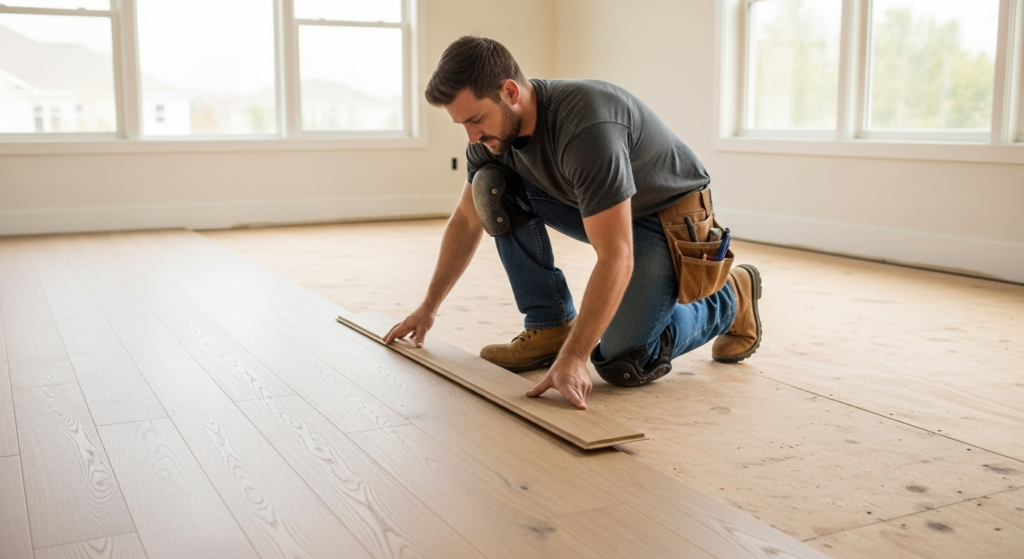
Common Mistakes Homeowners Make When Deciding When to Replace Hardwood Floors
Avoiding these mistakes ensures you make the right decision at the right time:
Refinishing floors that are past their sanding limit. Sanding a floor that has already been sanded to minimum thickness removes the tongue-and-groove joint, compromising the floor’s structural integrity. Always check the remaining thickness before scheduling a refinishing service.
Ignoring moisture damage and hoping it resolves. Mild cupping caused by a temporary humidity spike may resolve on its own. However, severe or persistent moisture damage will not improve without intervention — and delaying the decision of when to replace hardwood floors only allows the damage to worsen and spread to the subfloor.
Replacing floors without addressing the underlying moisture source. Installing new floors over an unresolved moisture problem guarantees that the new floors will suffer the same fate. Always identify and correct the moisture source before replacement.
Choosing replacement based on aesthetics alone. A floor that looks worn or outdated may be structurally sound and fully refinishable. Always get a professional assessment before deciding when to replace hardwood floors based on appearance.
Delaying replacement when multiple warning signs are present. When several of the warning signs in this guide are present simultaneously, further delay increases the risk of subfloor damage, mold growth, and safety hazards. Acting promptly when the signs are clear is always the right decision.
Not considering the full range of replacement options. Many homeowners default to replacing hardwood with hardwood without considering whether engineered wood, LVP, or tile might be a better fit for the specific room’s conditions and their lifestyle.
How Long Do Hardwood Floors Last? Setting Realistic Expectations
Understanding the typical lifespan of hardwood floors helps homeowners set realistic expectations for when to replace hardwood floors.
Solid hardwood flooring: 50–100 years with proper maintenance and periodic professional refinishing. The floor can be refinished 5–10 times over its lifetime, each cycle extending its useful life by 10–15 years.
Engineered hardwood flooring: 25–50 years with proper maintenance. Can be refinished 1–3 times depending on veneer thickness. In moisture-prone environments, engineered hardwood often outlasts solid hardwood.
Factors that shorten hardwood floor lifespan:
- Inadequate humidity management (the most common factor in Delaware and Pennsylvania)
- Use of steam mops or excessive moisture during cleaning
- Failure to address spills promptly
- Neglecting periodic professional refinishing
- Installation in inappropriate environments (basements, over concrete without moisture mitigation)
Factors that extend hardwood floor lifespan:
- Consistent humidity management between 35–55%
- Regular professional maintenance (screen-and-recoat every 3–5 years)
- Prompt spill response
- Felt pads under furniture and area rugs in high-traffic areas
- Professional installation with proper subfloor preparation
For more detailed guidance on extending your floor’s lifespan, explore our complete guide on hardwood and engineered wood flooring care and our sanding and refinishing services.
When to Replace Hardwood Floors
How do I know if my hardwood floors need to be replaced or just refinished? The key indicators for replacement are: the floor has been sanded to minimum thickness, severe moisture damage or warping is present, rot or mold is visible, the subfloor is damaged, or multiple compounding issues exist simultaneously. Surface scratches, dull finish, and light staining are refinishing situations, not replacement situations.
How many times can hardwood floors be refinished before replacement is needed? Solid hardwood floors can typically be refinished 5–10 times before replacement is needed, depending on the original thickness and how much material is removed in each cycle. Engineered hardwood can be refinished 1–3 times. Once the floor reaches minimum thickness, replacement is the only option.
What causes hardwood floors to need early replacement? The most common causes of premature hardwood floor replacement are moisture damage (from flooding, plumbing leaks, or inadequate humidity management), rot and mold from long-term moisture exposure, subfloor damage, and over-sanding from too many refinishing cycles. Proper maintenance and humidity management are the most effective ways to prevent early replacement.
How much does it cost to replace hardwood floors in Delaware and Pennsylvania? Hardwood floor replacement in Delaware and Pennsylvania typically costs $6–$12 per square foot installed for solid hardwood, or $5–$10 per square foot for engineered hardwood. The total cost depends on the species, plank width, subfloor condition, and the size of the area being replaced.
Should I replace hardwood floors before selling my home? It depends on the floor’s condition. If the floors show significant damage that would be a red flag for buyers, replacement or refinishing before listing is a worthwhile investment. If the floors are structurally sound but cosmetically worn, professional refinishing at $3–$5 per square foot is usually the better investment before a sale.
FAQ
Q: When should you replace hardwood floors instead of refinishing them? A: You should replace hardwood floors when the boards have been sanded to minimum thickness, severe moisture damage or warping is present, rot or mold is visible, the subfloor is damaged, or multiple compounding issues exist simultaneously. Surface wear and light scratches are refinishing situations, not replacement situations.
Q: How long do hardwood floors last before they need to be replaced? A: Solid hardwood floors last 50–100 years with proper maintenance and periodic refinishing. Engineered hardwood typically lasts 25–50 years. The actual lifespan depends on maintenance quality, humidity management, and the number of refinishing cycles the floor has undergone.
Q: What are the signs that hardwood floors need to be replaced? A: The eight key signs that indicate when to replace hardwood floors are: the floor has been sanded to minimum thickness, severe moisture damage is present, rot or mold is visible, the subfloor is damaged, widespread deep gouges cannot be sanded out, significant permanent gaps exist, the floor cannot be matched for repairs, and multiple compounding issues are present simultaneously.
Q: Is it worth replacing hardwood floors before selling a house? A: Yes, in most cases. Damaged or severely worn hardwood floors are a visible liability that reduces buyer confidence and sale price. Professional replacement or refinishing before listing typically delivers a strong return on investment in competitive markets like Wilmington, DE, and the greater Philadelphia suburban area.
Q: How much does hardwood floor replacement cost in Delaware and Pennsylvania? A: Hardwood floor replacement in Delaware and Pennsylvania costs $6–$12 per square foot installed for solid hardwood and $5–$10 per square foot for engineered hardwood. Subfloor repairs, if needed, add $1–$3 per square foot. Contact Prime Epoxy Flooring for a free, accurate estimate for your specific project.
Conclusion: Knowing When to Replace Hardwood Floors Protects Your Home and Your Investment
Understanding when to replace hardwood floors — and when refinishing is still the right answer — is one of the most financially important decisions a homeowner can make. Here is a summary of what you have learned:
The 8 warning signs that indicate when to replace hardwood floors are: the floor has been sanded to minimum thickness, severe moisture damage is present, rot or mold is visible, the subfloor is damaged, widespread deep gouges cannot be sanded out, significant permanent gaps exist, the floor cannot be matched for repairs, and multiple compounding issues are present simultaneously.
When replacement is necessary, your options include new solid hardwood, engineered hardwood, luxury vinyl plank, tile, and laminate — each with specific advantages depending on the room’s conditions and your lifestyle. The right choice depends on your subfloor type, moisture exposure, budget, and design goals.
At Prime Epoxy Flooring, we have helped hundreds of homeowners across Wilmington, Newark, Middletown, Bear, Smyrna, Townsend, Edgemoor, Rehoboth Beach, King of Prussia, Media, Norristown, Glen Mills, Broomall, and Greenville make the right flooring decision for their specific homes. Our team provides honest, expert assessments — never sales pressure — so you can invest with complete confidence.
Ready to find out whether your hardwood floors need refinishing or full replacement? Contact Prime Epoxy Flooring today for your free, no-obligation assessment. Call us at +1 (302) 600-2835, email info@primeepoxyflooring.com, or fill out our contact form here. We are available Monday–Friday 8AM–5PM and Saturday 8AM–12PM.
Company Information
Prime Epoxy Flooring 300 Cassidy Dr Ste 305, Wilmington, DE 19804, United States Phone: +1 (302) 600-2835 Email: info@primeepoxyflooring.